


HAPPY SONOGRAPHERS DAY!

October 10, 2026 | The CURE Center
There are people in this world who possess an extraordinary ability.
They can see inside the human body without making an incision.
They can watch a heart beating, follow blood through arteries and veins, witness a baby developing before birth, and recognize abnormalities that may change the course of someone's life.
They accomplish this using sound, without exposing patients to ionizing radiation.
These remarkable people are Diagnostic Medical Sonographers.
Today, October 10, we celebrate not simply what ultrasound can do, but the extraordinary journey that made it possible and the people who continue to move it forward.
From Bats to Sonar: Nature's Extraordinary Discovery

Millions of years before humans developed ultrasound, nature was already demonstrating the power of sound.
Bats navigated through darkness. Dolphins located objects beneath the water. Using echolocation, these animals produced sounds and interpreted returning echoes to understand their surroundings.
Nature had demonstrated something remarkable.
You don't need light to discover what you cannot see.
In the late 1700s, Italian scientist Lazzaro Spallanzani investigated how bats navigated in darkness. His experiments helped establish the importance of hearing, although the ultrasonic mechanism would not be understood until much later.
In 1880, brothers Pierre and Jacques Curie discovered the piezoelectric effect, an essential scientific foundation for the development of modern ultrasound transducers.
Following the Titanic disaster in 1912 and during World War I, scientists and engineers accelerated the development of underwater acoustic detection.
Researchers including Paul Langevin helped advance ultrasonic technologies capable of locating submerged objects.
Sonar was becoming a reality.
And a remarkable question emerged.
If sound could locate something hidden beneath the ocean, could it also reveal something hidden inside the human body?
From Echoes to Images: The Birth of Medical Ultrasound
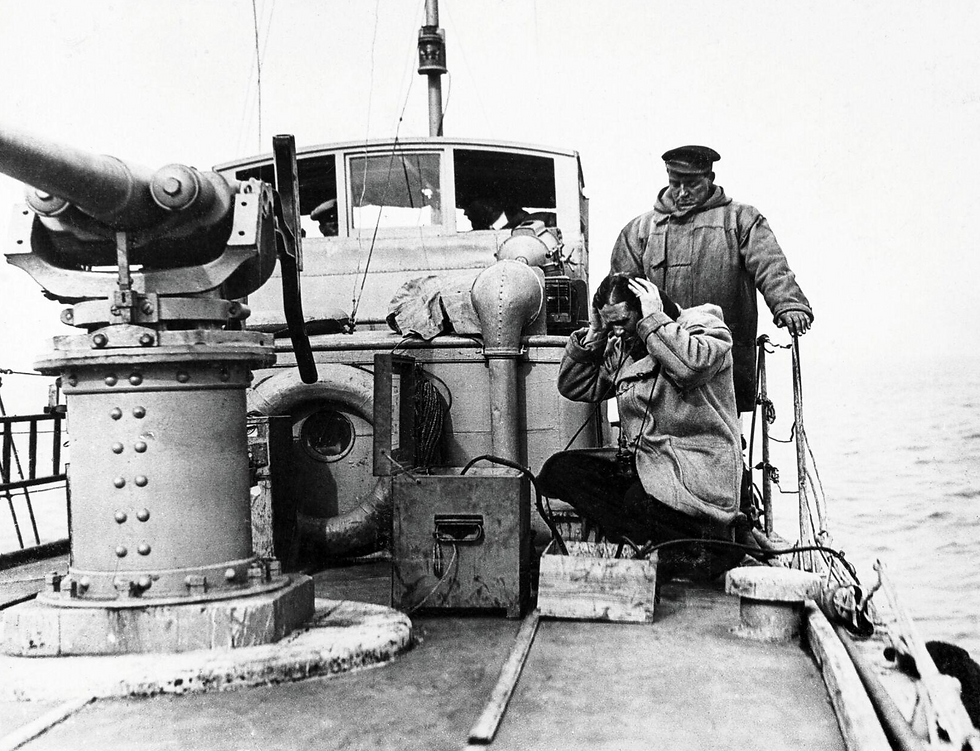
During the 1940s, Austrian physician Karl Dussik explored the use of ultrasound to investigate the human brain.
His experiments were limited by the technology available, but they helped establish an entirely new direction for medical investigation.
During the following decades, pioneers including John Wild, John Reid, Ian Donald, Tom Brown, Inge Edler, Carl Hellmuth Hertz, and many others advanced the use of ultrasound in medicine.
What began as dots, spikes, lines, and echoes gradually became recognizable anatomical images.

By the 1970s and 1980s, advances in real-time imaging and Doppler technology allowed clinicians to observe moving organs and investigate blood flow.
Color Doppler, digital imaging, three-dimensional and four-dimensional ultrasound, elastography, contrast-enhanced imaging, and portable ultrasound continued expanding the possibilities.
Today, ultrasound helps evaluate the heart, investigate vascular disease, assess fetal development, examine organs, identify abnormalities, and guide medical procedures.
We progressed from detecting echoes to watching life happen inside the human body.
And none of it happened overnight.
Each advancement built upon decades of scientific curiosity, experimentation, perseverance, and collaboration.
The People Who Built a Profession
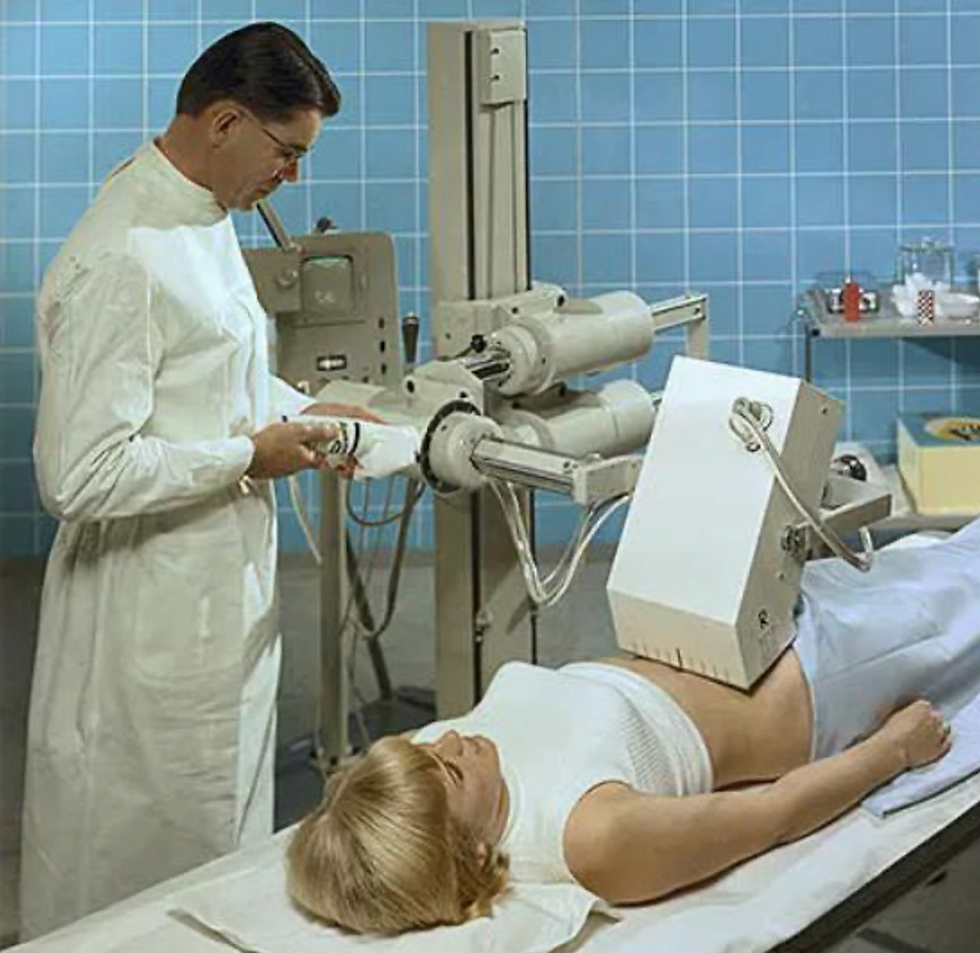
Technology alone does not create a healthcare profession.
People do.
The researchers who pursued discoveries that initially seemed impossible.
The engineers who transformed scientific principles into medical instruments.
The physicians and sonographers who developed examination techniques and demonstrated their clinical value.
The founders who established ultrasound schools and training programs.
The teachers who developed curricula, taught anatomy and physics, and insisted that students understand what they were seeing rather than simply memorize images.
The clinical preceptors who turned classroom knowledge into practical competency.
And the professional organizations that helped establish standards, advance research, support education, and strengthen professional recognition.

Today, we acknowledge the contributions of the Society of Diagnostic Medical Sonography (SDMS), the American Institute of Ultrasound in Medicine (AIUM), the Society for Vascular Ultrasound (SVU), the American Society of Echocardiography (ASE), the American Registry for Diagnostic Medical Sonography (ARDMS), and Cardiovascular Credentialing International (CCI).
Their work, together with the dedication of countless educators and healthcare professionals, helped shape modern sonography.
We also recognize the founders and leaders of independent, nonprofit, community-based, hospital-based, and other mission-driven ultrasound programs.
Particularly those who have chosen to remain independently operated, outside private equity ownership, to protect their educational mission.
Ownership alone does not determine educational quality. But the commitment to placing student competency, educational integrity, and patient care ahead of financial performance deserves recognition.
The value of an ultrasound school is ultimately reflected in the professionals it prepares and the care those professionals provide.
Consider the lasting influence of a single exceptional instructor.
A teacher prepares 20 students. Those students graduate, enter clinical practice, and perform thousands of examinations throughout their careers. Some eventually become instructors themselves.
The knowledge of that original teacher continues through patients and future generations of sonographers they may never meet.
That is the remarkable legacy of education.
Have You Ever Considered How Many Lives You Touch?
Now consider the collective reach of this profession.
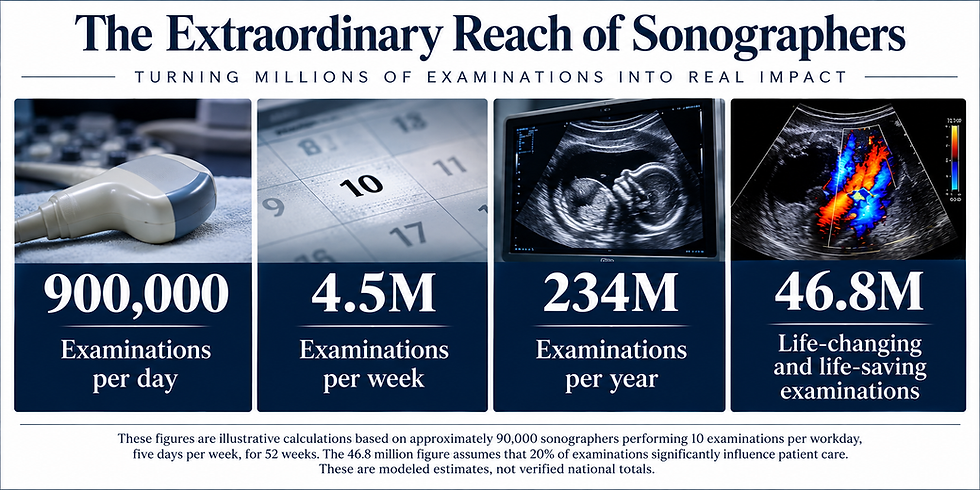
Using approximately 90,000 diagnostic medical sonography positions in the United States, imagine that each represents a sonographer performing 10 examinations per day, five days per week.
That would produce:
900,000 examinations every day.
4.5 million examinations every week.
234 million examinations every year.
And if just 20% of those examinations significantly influenced a patient's care, diagnosis, treatment, or future, that would represent 46.8 million potentially life-changing examinations annually.
These are illustrative calculations based on assumed workloads and outcomes, not measured national totals. They count examinations rather than necessarily unique patients, and the 20% assumption is not an established clinical rate.
But behind those numbers is a much more important question.
How many babies have been delivered safely because an ultrasound identified a complication?
How many mothers received timely treatment because a sonographer recognized something concerning?
How many fathers are still here to watch their children grow?
How many grandparents have celebrated another birthday?
How many families have been given more time together?
We cannot calculate the exact number of lives saved by ultrasound. But we can recognize its extraordinary influence on clinical decisions, patient care, and the people whose futures depend on them.
Sometimes the greatest impact of an examination is something the sonographer will never know.
A patient who recovered.
A diagnosis made in time.
A family that remained together.
A future that continued.
From Images to Impact: The Future of Sound

And now, the evolution of ultrasound has entered another remarkable chapter.
Sound is increasingly being used not only to investigate disease, but also to treat it.
Therapeutic ultrasound has been studied for decades. Today, advances in focused ultrasound, high-intensity focused ultrasound (HIFU), thermal ablation, and histotripsy are expanding its medical applications.

In countries including China, the United States, France, South Korea, Germany, Japan, Israel, and the United Kingdom, these technologies are being used or investigated for selected tumors, uterine fibroids, movement disorders, and other conditions.
Focused ultrasound can concentrate acoustic energy within selected tissues. Some treatments use heat, while techniques such as histotripsy use mechanical effects to disrupt targeted tissue.
Certain procedures can be performed without a surgical incision.
More than one million focused ultrasound treatments had been reported worldwide by the end of 2025.
These therapeutic procedures are generally performed by physicians and multidisciplinary clinical teams, and not every application is established or appropriate for every patient.
Nevertheless, consider the scientific journey.
We began by using sound to locate objects hidden beneath the ocean.
We learned to visualize anatomy inside the human body.
We developed techniques to evaluate blood flow, tissue characteristics, and disease.
And today, we are increasingly using acoustic energy to treat selected medical conditions.
FROM IMAGES TO IMPACT.
What began as a way to discover what could not be seen has become an extraordinary field of medical science.
And its possibilities are still unfolding.
Three Students. One Idea. A Day for All of You.
Sonographers' Day, October 10, holds special meaning for our CURE and ADOM Academy family.
In 2025, three ADOM Academy students, Mary Vincent, Victoria Siple, and Connor Trainor, were given a simple assignment.
Create something.
They chose to create Sonographers' Day, celebrated on October 10, or 10/10, to recognize the people who have dedicated their careers to ultrasound.
This year, Mary, Victoria, and Connor have graduated from ADOM Academy and are now part of the profession they chose to celebrate.
We want to thank Mary, Victoria, and Connor for creating Sonographers' Day and congratulate them on their graduation. What started as a classroom assignment has given us an opportunity to recognize the contributions of sonographers, past and present.
And this year's date brings an interesting numerical coincidence.
October 10, 2026 is 10/10/26.
Add the digits of the year:
2 + 0 + 2 + 6 = 10
That gives us:
10 / 10 / 10
The tenth day, the tenth month, and a year whose digits add up to ten.
For those who enjoy numerology, the number 10 is often associated with completion, new beginnings, and achievement. It's particularly fitting this year, as the students who created Sonographers' Day have just completed their education and are beginning their careers.
10/10/10. A special date to celebrate sonographers and the three ADOM Academy graduates who started it.
To the Next Generation
To every student preparing to enter sonography, you are inheriting an extraordinary scientific legacy.
But the future of this profession will require more than the ability to obtain excellent images.
It will require curiosity.
An understanding of anatomy, physiology, physics, and pathology.
The ability to recognize what is normal, investigate what is abnormal, and understand why those differences matter.
The willingness to keep learning as medicine and technology evolve.
And the compassion to remember that behind every examination is a human being who may be frightened, uncertain, or waiting for an answer.
SEE MORE. KNOW MORE. DO MORE.
See beyond the obvious.
Know more than what appears on the screen.
Do more with the knowledge and opportunities this remarkable profession provides.
Because somewhere, someday, someone will depend on what you know.
And This Deserves to Be Celebrated.
Not simply because of how far ultrasound has come, but because of the extraordinary people who brought us here.
From nature's echoes to sonar. From dots on a screen to seeing life in motion. From discovering disease to treating it.
What an extraordinary journey.
And what an extraordinary group of people who have made it possible.
The pioneers who imagined the impossible.
The scientists who challenged what we knew.
The founders who built the institutions.
The educators who dedicated their lives to teaching.
The organizations that nurtured the profession.
And the sonographers who, every day, turn the science of sound into something profoundly human.
This is why Sonographers' Day matters.
Because behind every advancement and every discovery are people who cared enough to keep learning, keep questioning, and keep going.
And behind every examination is the possibility of changing someone's life.
That deserves more than recognition.
It deserves a day of celebration.
HAPPY SONOGRAPHERS' DAY!
OCTOBER 10, 2026
To every sonographer, past, present, and future:
You may never know how many lives you have saved, how many futures you have changed, or how many families are still together because of something you discovered.
But today, we want you to know something.
What you do matters.
And the world is a better place because you do it. The world is a safer place because of you.
The CURE Center
Read the original story: The Birth of Sonographer Day, 10/10
From nature's echoes to the extraordinary possibilities of modern medicine, a celebration of the people who made it possible.



Comments